
Visiting Yellowstone - Part One
On Traveling to Yellowstone and the Park's Entrances

This is the first in a multi-part series intended to help inexperienced park visitors plan a visit to Yellowstone. Here is how I intend to break things out:
Part One: I’ll highlight travel to the greater Yellowstone area and explore the various locations from which one can enter the park. This is baseline information from which we’ll build.
Part Two: I’ll talk about where lodging can be found, the advantages and disadvantages of these options, and also spend some time discussing what to expect when traveling around the park. The location of your accommodations and the things you want to see inside the park are inextricably linked and your choices can save or cost you a lot of travel time.
Part Three: Depending upon whether you fly or drive to Yellowstone, I’ll offer some pointers about what you can/should take along to make your Yellowstone trip more enjoyable, more convenient, and more economical.
Part Four: I’ll use my final post on this topic to offer you some of my personal opinions, tips, and tricks for making the most of your visit and making sure you see the best of Yellowstone.
Yellowstone’s geography
The vast majority (96%) of Yellowstone’s 3,472 square miles sit in the northwest corner of Wyoming, although the park’s northern and western boundaries push into Montana (3%) and Idaho (1%). In fact, two of the park’s three busiest entrance gates - the West and North entrances - are located in Montana (in the towns of West Yellowstone and Gardiner, respectively).
Yellowstone sits amidst the Middle Rocky Mountain province, which includes the northwest corner of Colorado, along with parts of Utah, Idaho, Wyoming and southern Montana. Due to its mountainous terrain, elevation in the park varies widely, but on average, the park sits at roughly 8,000 feet above sea level. This fact is often lost on first time park visitors who tend to think first of Yellowstone’s signature geysers and thermal pools more so than its high elevation and rugged mountain terrain. Consider that the “Mile High City” of Denver, CO sits at around 5,300 ft. and realize that the average elevation is Yellowstone is a very substantial 2,700 ft. higher.
Getting to the park
Yellowstone is not near any major U.S. airport. The nearest major air hub is Salt Lake City, which is 325 miles and a 5 hour drive from the park. The nearest regional airports are Bozeman Yellowstone International Airport (BZN), which is around 90 miles from both the North and West entrances to Yellowstone; the Jackson Hole, Wyoming Airport (JAC), which is about 50 miles from the South entrance to Yellowstone; and the Yellowstone Regional Airport (COD) in Cody, WY, which is about 50 miles from the East entrance to the park.
Of the three, Bozeman sees more passengers annually and will offer travelers more flights from which to choose. In the 12 months ending in March of 2024, the top three airlines servicing Bozeman Yellowstone saw 1.54 million passengers board their planes. Jackson Hole, by comparison, saw just over 800k passengers for the 12 months ending in August, 2023. Only about 40k passengers come through the Yellowstone Regional Airport annually.
There is also an airport in West Yellowstone (WYS) serviced by Delta and United from May through October, but flights are extremely limited and expensive. You can check the arrival and departure schedule for yourself. A quick scan of the month of June, 2024 showed that most days average a total of two or three inbound flights per day, with an outbound schedule to match. The only airports serviced are Denver and Salt Lake City, so unless you’re coming directly from those locations, you’ll have to make a connection.
As a long-time veteran of air travel, I’d caution you against connections into locations with as few alternatives as West Yellowstone and Cody. If it all works out, West Yellowstone would be very convenient, but if your flight into DEN or SLC is canceled or significantly delayed, causing you to miss your flight to West Yellowstone, expect your vacation to be pushed back by a full day, and that’s if there is capacity for your party on the next flight, which is no guarantee.
If you opt to fly to Yellowstone, it’s a must for air travelers to rent ground transportation at their destination airport. As crazy as it is to have to say this, I’ve seen questions posed on the park’s social media accounts inquiring about the availability of ride share services like Uber and Lyft for getting to, from, and around Yellowstone. The answer to that is a firm “no.”
If you’re within driving distance of Yellowstone, I strongly encourage opting for your own wheels. In addition to controlling your own itinerary and saving on airfare, you likely own a lot of things that you wouldn’t consider packing for a flight but which can make your trip to Yellowstone easier, more enjoyable, and more economical (even in addition to saving on airfare). More on this in a future post.
Getting into and out of the Park
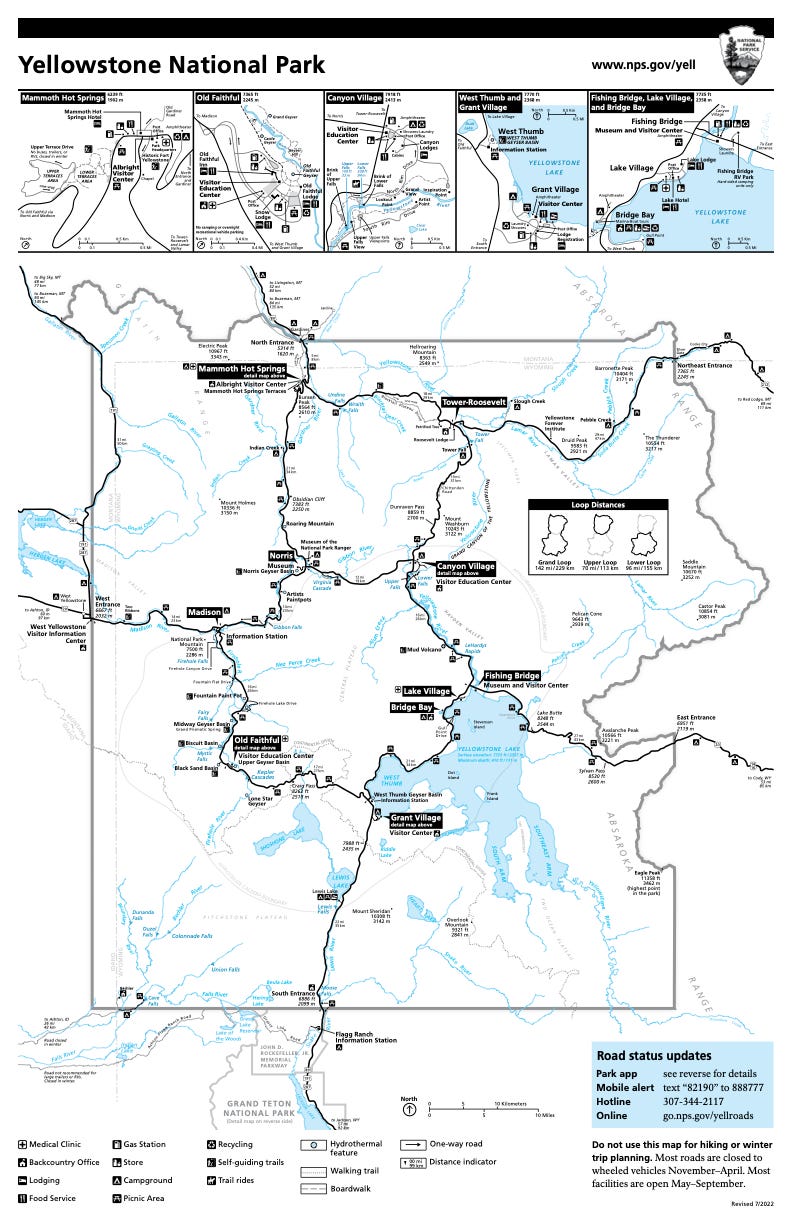
There are five gates through which one can enter and exit the park via motorized vehicle: North, Northeast, East, South, and West. I’ll talk briefly about each.
The North entrance is located in the small town of Gardiner, MT and is the third busiest of the park’s entrances. You’ve likely seen the famous Roosevelt Arch that greets visitors entering the park from north. Gardiner is approximately 88 miles from the Bozeman Yellowstone airport, a drive that will take roughly 1 hour 40 minutes under normal conditions. The North entrance is one of only two that is open year round.
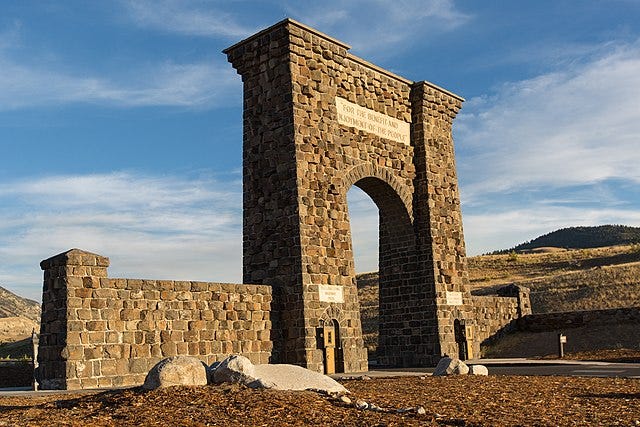
The Roosevelt Arch greets park visitors entering from Gardiner, MT.
The Northeast represents the second of the two entrances open year round but sees the least amount of traffic. It is located just outside the tiny town of Cooke City, MT. If you’re entering Yellowstone for the first time through the Northeast entrance, you’ve just completed what the Yellowstone Compass considers one of the most epic drives in the Lower 48. That is, you’ve traversed the Beartooth Highway from the town of Red Lodge, MT. This entrance would most likely be used by those driving to Yellowstone from the east via Interstate 94, or perhaps those who flew into Billings (a drive of approximately 2 hours 45 minutes from Yellowstone). If you’ve never before driven in the mountains or have a fear of heights, this might not be the route for you to take. While the views from the Beartooth Highway are absolutely stunning, there are very narrow shoulders and precipitous drop-offs in some places. It can be a white-knuckle drive for the squeamish. Note that the Beartooth Highway is typically closed for more than half of the year, accounting for the relatively low usage of the NE entrance. In most years, the Beartooth Hwy. closes in mid- to late-October and often doesn’t open until Memorial Day weekend or later. Even after the road has opened for the season, temporary closures due to weather can happen, so be sure to have a backup plan if you expect to cross Beartooth Pass on your way into Yellowstone.
The East entrance ranks fourth in terms of the number of visitors who pass through its gate annually. The nearest town to the east entrance is Cody, WY, which has a population of 10,224, making it and Jackson, WY the largest of Yellowstone’s gateway communities, if they’re really close enough to consider them as such (I’m not sure I do). Cody is about 52 miles from the East entrance to Yellowstone, a drive that will take just over an hour. The East entrance is not open year round. It typically closes in early November and re-opens in April, once the park is able to clear roads of snow and resume normal operations for the season. The East entrance is often the last of the five to open in the Spring.
The South entrance is the second busiest. To enter Yellowstone via the South necessitates that you first travel through Grand Teton National Park and up the Rockefeller Parkway. The Rockefeller Parkway is a short 7-mile stretch of road that connects the two national parks; it takes only about 15 minutes to travel between the two. Jackson, WY acts as the gateway to the Tetons and is similar to Cody both in size (about 10,698 residents) and travel time to Yellowstone. That travel time, though, assumes you drive through the Tetons without stopping. If you’ve never been there before and are simply passing through on your way to Yellowstone, you’ll not be able to resist stopping at some of the scenic pullouts and gazing in awe at the rugged Teton peaks. The Ashton-Flagg Ranch Road does provide a means of accessing the Rockefeller Parkway from the west without going through the Tetons, but it is impractical for anyone but the locals who live in the small rural towns of eastern Idaho. Like the East entrance, the South entrance is open seasonally and you’ll not be able to enter the park this way between November and April.
The West entrance is the busiest of all five park entrances by a wide margin, typically accounting for approximately twice as much traffic as the South entrance. The town of West Yellowstone, with its bustling population of 1,244, sits just outside the west gate. Travelers driving to Yellowstone from points further west will likely find this to be the most convenient entrance. West Yellowstone is about 91 miles from the Bozeman Yellowstone airport, a drive which will take about 1 hour 45 minutes under normal conditions, making it virtually equidistant from that airport as the town of Gardiner and the North entrance. If you’re flying into Bozeman for your visit to Yellowstone, you can consider either Gardiner or West Yellowstone as good options for lodging if you haven’t secured accommodations within the park itself. The West entrance is also open only from April - November though it is typically the first of the three seasonal entrances to open for visitors in the Spring.
When the park opens in April, it’s open until it closes in November, barring some unforeseen event like the flooding of 2022 or the pandemic of 2020. There are no limitations as to the time of day when one can enter the park. The gates are not staffed 24 hours per day but they remain open. However, one must exercise extreme caution when driving through Yellowstone at night. Wildlife is everywhere in the park; cell phone service is not. Park roadways are not illuminated and it can be difficult to see wildlife (e.g. bison) in the dark. If you would happen to hit a large animal and damage your vehicle to a point where it couldn’t be driven, expect to be stuck until a park ranger comes by, and further until the ranger can summon a tow truck from the nearest town, which might be the next morning. If you’re a member of AAA or another roadside assistance program, read the fine print of your agreement or call and speak with a live body. Most likely your service does not cover you inside Yellowstone. Again, exercise extreme caution at night.
I didn’t delve into winter oversnow travel, but I’ll save that topic for a post later in the year.
Park Fees
I won’t spend much time here because this is all documented on the park web site, but since we’ve covered so much information about the park entrances, I’d be remiss to omit entrance fees. I’ll keep it short. Here’s the gist:
Passenger vehicle entrance into Yellowstone is $35. When you enter the park the first time (provided you do so during hours when the gates are staffed), you’ll pay this fee and be given a receipt along with a park map. Keep that receipt! It will get you back into the park for seven days. If your stay extends beyond seven days, you’ll need to pay again upon entering the park on Day 8.
If you enter via the South gate (i.e. Grand Teton National Park), you’ll still need to purchase entry to Yellowstone. One entrance fee used to get you into both parks, but they changed that a few years ago and separate entrance fees are now required.
The motorcycle entrance fee is $30.
If you enter on foot, the fee is supposedly $20. This one’s kind of a mystery to me. I’ve been through the gates to the park more times than I can count, and I have yet to ever see a pedestrian walking in, much less stopping to pay an entrance fee. There are certainly quite a few hiking trails that cross the park boundary, but trust me, there are no rangers stationed out there to collect your $20.
There are myriad other options to cover park entrance fees, including annual passes, senior citizen discounts, military discounts, and more. Consult the link above for all the specifics.
I hope you’ll come back for Part Two on Friday.
Have questions or comments? Please let me know! If you found this interesting, please share it.